Los Alamos Mountaineers
You are here
Adventure and Exploration at the Brazos Cliffs
The early history of the Mountaineers is closely linked to the era of discovery, exploration, adventure, and misadventure in the Brazos Cliffs near Tierra Amarilla in northern New Mexico. The cliff escarpment is about 3000 feet high and extends for roughly 2 miles on the west side of the Brazos Box canyon and about 1 mile on the east side. The climbing routes on the main walls are roughly 2000 feet high and range in length from 10 to 17 pitches. So there are literally several square miles of rock to explore, providing nearly endless climbing possibilities.

Fig. 1. The Main Brazos Cliffs as seen from the South. The most popular route, Easy Ridge, ascends the ridge just right of the highest point on the cliffs and just right of the large dihedral called the Bowling Alley. The Great Couloir Direct climb is just left of the high point.
George and Ginny Bell were the first to explore the Brazos Cliffs. Ginny Bell moved to Los Alamos in 1950 and George arrived in 1952, where he was a driving force in the Theoretical Physics Division at LANL for almost 50 years. George was also an avid mountaineer and outdoorsman. He participated in 4 expeditions to the Peruvian Andes in the 1950's, including first ascents of two of Peru's highest and most difficult peaks. He was a member of the 1953 American expedition to K-2 (described in a later section on "Memorable Programs.)" George and Ginny Bell met at a Mountaineers' meeting just before he left to join the K-2 expedition. Ginny Bell had done ballet and acrobatics when she was at the University of Wisconsin. She recalls that she had no fear of heights on rock and that she found climbing easy! In 1952, George Bell, Virginia Lotz, Don Monk, and K. Brueckner made the first ascent of "Easy Ridge." (Note added by Skip Bell -- Virginia Lotz is the maiden name of Ginny Bell.) Later that year George Bell and Don Monk did the first ascent of the Great Couloir.

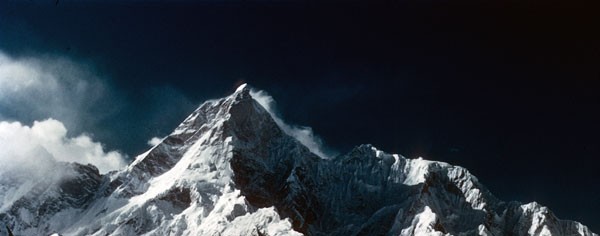
Fig. 2. George Bell on the first ascent of Masherbrum in 1960 (Nicholas Clinch photo).
George Bell prepared an article (see LAM Historical Binder) on the Brazos for the Colorado Mountain Club's Trail and Timberline publication. The article, dated March 1972, is the only published guide to the area. George provided an excellent description of the cliffs and marked the routes known at that time, including the names and dates of the first ascent parties. The article includes pictures of the Main Cliffs, the Brazos Box area, and the Wedge. Don Monk also wrote up notes on climbing in the Brazos (also in LAM Historical Binder).
George Bell began his article on the Brazos with the following well-phrased introduction:
"Nowadays, when a climber stumbles onto a particularly fine but unknown area, he is tempted to talk little about it except to a few chosen friends. Better to at least get in some of the choicest routes before mentioning it in climbing journals and before encouraging the hordes of other climbers to our cliffs. So, for the last twenty years, we in Los Alamos have been enjoying our favorite Brazos Cliffs in Northern New Mexico, not exactly secretly, since who can keep two-thousand foot cliffs secret when they are plainly visible from a U.S. highway eight miles away, but at least quietly . . ."
"For those who wish to read no farther the lesson is this: though the cliffs look nice enough from a distance they have many bad characteristics and consequently should be avoided by the inexperienced. For one thing, the rock is a particularly hard quartzite which will defeat all attempts to drill bolt holes; while cracks abound, they will frequently scratch or refuse to relinquish pitons; though good holds are common, a few areas are water polished and the rock is exceedingly slick when wet. Where the holds and the protection are plentiful, the quartzite is often brittle and dangerously loose. Many holds must be carefully tested before applying weight and many belay ledges are loaded with piles of sharp loose rocks."
To elaborate on George Bell's description, Brazos rock is a sharp, heavily fractured quartzite, which breaks the cliffs into a series of fractured ridges and water-worn couloirs. The faces to the west of each ridge tend to be smooth, steep, and heavily lichen-covered and were therefore usually unclimbable. The ridges themselves, and the faces to the east of them, tended to have good crack, corner, and face climbing options. George Bell's article also cautioned climbers that, "despite the easy ratings, climbing in the Brazos is a serious mountaineering experience!” Pioneers like George Bell and Don Liska climbed alpine-style, moving fast and placing very few pitons. Sometimes their reports of the total number of pitons used (an amazingly low number!) makes it seem like they were soloing the routes. The ratings may appear low compared to modern sport climbing. But the need to climb all day and worry about the weather made it impractical to hang around and work on individual hard moves. If a summer thunderstorm came up, the danger from lightning was high. Even worse, once the lichen-covered rock became wet, it became so slimy that it was almost impossible to keep climbing upwards. Climbers either had to wait hours until the rock dried out, or start a long series of dangerous rappels, exhausting their lead racks to place anchors.
Lastly, route finding was a never-ending challenge that required constant attention to the lay of the rock and the best climbing direction. Almost all of the early Mountaineers could look back and remember at least one time that they actually started up the wrong route, not realizing it until it was too late to start over! And once the top was reached, sometimes close to dark or after dark, the descent gully provided more route-finding, scree, and rock-rolling challenges for the tired climber. Thus fear, loathing, and stomach-turning stress were often part of climbs in the Brazos.

Fig. 3. Mike Williams and Bill Frye on Easy Ridge during the 1969 climbing school graduation climb, showing a typical rubble-covered belay ledge (Bob Cowan photo, May 1969).
Climbing in the Brazos was truly an adventure, requiring very early starts, long approaches, route finding skills, keeping an eye on the weather, and offering great exposure, tremendous views, and the smell of wild licorice-flavored anise plants growing among the rocks. Don Liska came to Los Alamos in 1966 and climbed in the Brazos as late as 2003, a 38-year period. He recalls that "My first climb with the mountaineers occurred only 2 weeks after we arrived in Los Alamos in June, 1966. We climbed Easy Ridge. Emily Willbanks and Ken Ewing were there. We did overnights in those early days and slept out near the Brazos Lodge. It was a pretty big deal, going to the Brazos in the 60's. One could not buy gas in Los Alamos as the only station closed on weekends. You could get a little gas from the police but you had to have enough to reach Espanola. Sometimes people would run out on the way." Don Liska, Dick Ingram, George Goedecke, and Paul Wholt did the first ascent of the Great Couloir by the Direct Finish (17 pitches) later in 1966.
Len Margolin came to Los Alamos in 1969 and quickly became one of the club's strongest climbers. He said that climbers like himself and Don Liska "had the low-hanging fruit." They could do everything for the first time and didn't have to worry about style, etc. Don said that "We got so familiar with the Brazos we did all sorts of obscure 'firsts' and tied all routes together with hair-raising traverses. We would bring back the licorice-smelling plant on those cliffs and keep it in a jar at home for weeks, always reminding us of 'unfinished work' at the Brazos. On one juvenile stunt, Larry Dauelsberg, Ernie Anderson, and I dashed out to the Brazos in June 1968 to do the 'Direct Start to Easy Ridge' which added 5 pitches to the standard 10-pitch route and made Easy Ridge one of the longer climbs on the face. The juvenile part was a rumor we heard that some other local climber had his mind on that route. It shows how determined LAMC climbers were in those days to do new things at the Brazos. Several of us also did winter explorations of the Brazos cliffs and tried dead-winter ascents. On one attempt on Easy Ridge we were three pitches into the route when a ton of ice came down and chopped the belay tree off at the five foot level. This made us stop and immediately descend."
Don Liska recalls that "On the 1968 first ascent of Gothic Arches Buttress we took four weeks to work out the route, returning to Los Alamos between weekends. On the last weekend, near the top and climbing by moonlight, I zippered out a string of direct aid pitons and was caught on a 30' fall by my buddies. Gothic Arches was a high caliber route in those days, rated 5.7 and 22 pitches. Why did we climb by moonlight? Well, to have a comfortable bivouac at the top of course. Instead we had an uncomfortable bivouac on the face. I should at least have used hero loops and a swami belt. Seat harnesses were rare in those days and individually wrapped out of 1" tubular webbing.

Fig. 4. Roland Pettit, club member and author of a Jemez hiking guidebook, wading in the Brazos Box (Bob Cowan photo, September 1976).
Climbs on the Brazos Wedge or in the Brazos Box could also be approached from the highway between Tierra Amarilla and Tres Piedras, or from a rough jeep road on the south side of the Brazos River. Because of the longer approaches, Brazos Wedge climbs were commonly done near the end of September or in early October to enjoy the fall colors and avoid afternoon thunderstorms.
An anecdote that provides an example of access issues in this area was provided by Don Liska: "In the 1980's Mark Zander and I decided to go into the Brazos Box and climb Razor Ridge together. We were audacious and fit in those days, so we drove Mark’s old pickup through the Tierra Amarilla community fields and parked at the usual spot, on Emmet Mundy’s property, in the boondocks above the entrance to the Box. We climbed down to the river and waded upstream to the start of the climb. Despite its middle 5th class rating we scrambled up the route unroped gripping the edge of the razor and yelling in joy. We finally sobered and condescended to rope up for the final pitch mainly because we felt foolish carrying the rope and not using it all that way."
"We topped out and then descended the gully back into the Box and returned to the car. We found a note on the windshield that read 'You are trespassing. Your time will come.' We had no idea who left the note but its threatening vein truly scared us. We gently lifted the hood and checked all around for a bomb. Finding nothing we headed back out along the old stagecoach road. Crossing back across the community field we spotted a horseman galloping towards us at full speed. He cut us off and he looked really intimidating with his six-gun and on a huge grey heaving horse. It was a truly wild west stickup scene. It was Emmet Mundy himself and he was mad as hell. He accused us of poaching. We tried to argue as he had gotten us a bit mad too. Finally we revealed we were climbers and had just done a route in the Box. When he heard that, he right away turned to smiles and friendly handshakes. Do you know Dr. Bell?' he asked. Of course we knew George well and then the conversation became very mellow and friendly. 'Come back anytime,' said Emmet as we drove off for home."
"It turned out that Emmet had seen an old NRA sticker on the rear window of the camper top on Mark’s old pickup – a sticker that came with the used vehicle. Emmet thereby assumed we were out there either plinking or poaching. However, since we were merely climbers (whom he admired as somewhat crazy 'great guys' like his friend George Bell) he forgave all and apologized for the mistaken identity. So Mark and I not only proved him to be right with our crazy ropeless climb of Razor Ridge, but we also won a real cowboy friend. We never saw Emmet again."
For almost two decades, roughly half of all the Mountaineers' summer or fall climbing trips had the Brazos as their destination. The climbing season would begin with the climbing school, which gave everyone a chance to get warmed up. After the graduation climb, the Mountaineers would start going to the Brazos. During the summer, climbers went to the Brazos almost every weekend, except at the peak of the rainy season when the risk of getting caught in a thunderstorm was just too high. The season usually ended with a trip to the Wedge in early October, when the first snowflakes started to come down.
During these years the Mountaineers continued to put up new routes or new variations on existing routes. Don Liska and Larry Campbell put up Cat Burglar in 1971. Merle Wheeler, Carl Keller, Len Margolin, and George Rinker did Resignation Ridge in August 1974, naming the climb in "honor" of President Nixon, who had resigned earlier that week. Chris Foster, Dave Barlow, Ralph Menikoff, and Norbert Ensslin put up the 15-pitch Relentless Ridge in 1983, choosing this name because it took 3 attempts, with a bivouac on each attempt, to finally reach the top. The bivouac ledge was not so bad, however. It was called the "Brazos Hilton" because it was 200 feet long, 50 feet wide, and covered with thick lush grass.
Up through the 1980's, the period of most climbing activity in the Brazos, roughly 45 routes or major route variations were named and documented. In 1986 the club voted against assembling these into a guidebook to help preserve the sense of wildness that is so unique to these cliffs and to give future generations of climbers a chance to re-discover the cliffs for themselves. However, to preserve a record of the Mountaineers’ climbing history, these route descriptions, mostly written by the early pioneers themselves, are now stored on this website (linked here).
Given the serious rockfall, endurance, accident and liability issues associated with climbing on these cliffs, it may be understandable that the Brazos have reverted back to wilderness. Over the past two decades the cliffs have seen very little use. With the advent of sport climbing and the availability of many fine new climbing areas with better quality rock within several hours' drive of Los Alamos, few people are still interested in the level of commitment and risk required to climb in the Brazos. Jim Straight remembers that he may have led the last big club trip to the Brazos in the mid-1980's. The trip had about 40 participants and was just too crowded for anyone to want to lead it. With some of the climbers inevitably getting lost or climbing too slowly and then getting stuck on top in the dark, Club trips to the Brazos were always a strain on some of the participants as well as on the trip leader.
For many years the landowners' agents, Bob and Irene Hobson, asked all climbers to register in a logbook at their cabin before starting up the cliffs. This was a way of formally requesting permission to climb, which in some years was granted only to members of the Mountaineers. The Hobsons have now passed away. At their request, Don Liska, Len Margolin, and Norbert Ensslin took their ashes to the top of the cliffs and distributed them at a spot that appears to be the top of the cliffs, as seen from the Hobson's former cabin in the valley below. The Hobson's registration system is no longer in use. At this point in time (2026), climbers who want to seek permission to climb the cliffs should contact Corkin's Lodge. However, it is unlikely that permission would be granted.
Theme by Danetsoft and Danang Probo Sayekti inspired by Maksimer